

MongoDB server must be in a replica set. If your pipeline only has a
standalone server, you can create a replica set with one member.Need help? Check out this guide.Using AWS DocumentDB? See our DocumentDB guide instead.
Required settings
- Connection string
- Service account
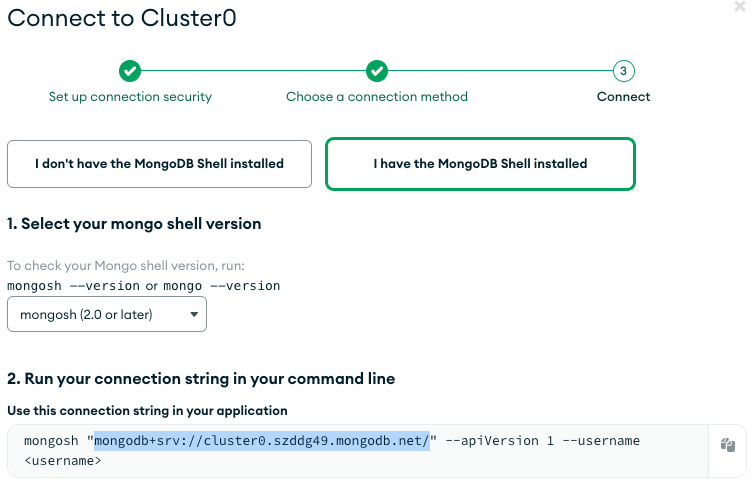
Connection string
- Go to Atlas UI
- Find your pipeline and click “Connect”
Retrieve connection string from Atlas
Retrieve connection string from Atlas
Service account
You can create a service account through the Atlas UI or by running a script.Option #1 - Atlas UI
Option #1 - Atlas UI
-
Click on
Database Accesson the left -
Click on
Add New Database User -
Under
Database User Privileges, openBuilt-in Roleand SelectOnly read any database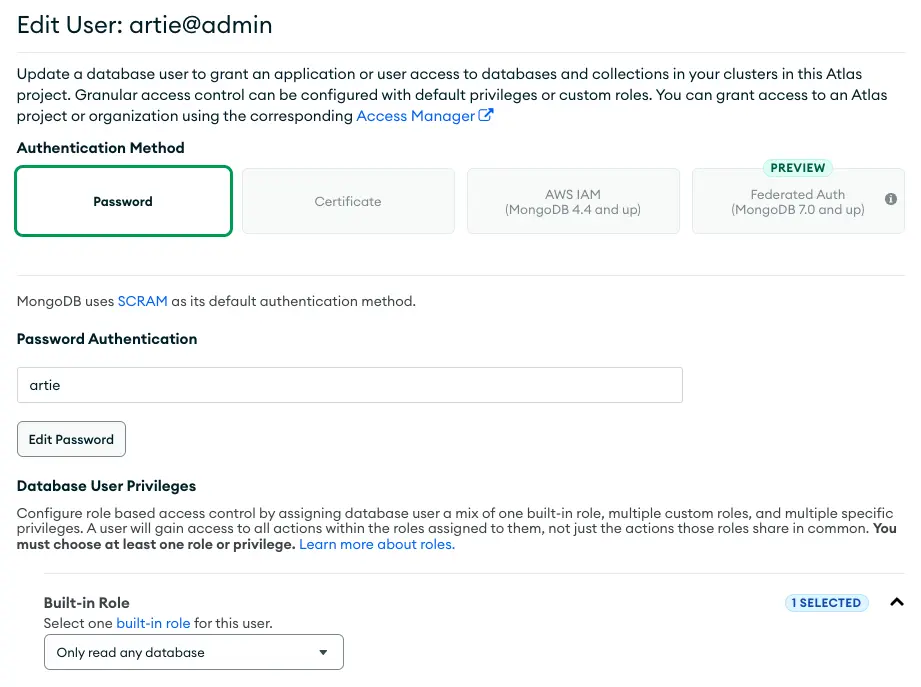
Option #2 - Service account script
Option #2 - Service account script
Advanced
Enabling full document before change
Enabling full document before change
This feature requires MongoDB 6.0 or later.
How do you handle typing and nested fields?
How do you handle typing and nested fields?
Data types: Artie determines the data type for each field by looking at the first non-null value and using its BSON type. This type is then mapped to the appropriate destination column type.Mixed-type fields: If the same field contains different BSON types across documents (for example, Artie will output Note that BSON-specific types (like
age: 25 in one document and age: "twenty-five" in another), Artie will land that field as a string in the destination. You can cast it to the desired type downstream.Sparse / dynamic fields: MongoDB collections often have documents with different sets of keys. Artie unions the schema across all observed documents. Fields that are absent from a given document are written as NULL in the destination.Nested objects: Nested documents and arrays are preserved as JSON objects in the destination. Artie does not flatten or unfurl nested structures into separate columns.For example, if the source document contains:test_nested_object as:$timestamp) are converted to standard formats. If the destination does not support a VARIANT or semi-structured type, the nested object will be stored as a JSON string.Cast all columns to string
Cast all columns to string
MongoDB collections have no enforced schema, so different documents can store the same field with different types. By default, Artie infers the column type from the first non-null value it sees. If a later document stores that field with a different type, Artie lands the column as a string.The Cast all columns to string setting makes this explicit: every column is stored as a string as it is discovered, regardless of the underlying BSON type. Nested objects are stored as JSON strings.This setting applies to new columns as they are discovered. Existing destination columns keep their current types. To cast all columns as strings on a pipeline with an existing destination table, rebuild the table after enabling this setting.You can enable this from your pipeline’s destination advanced settings.