

- Control plane - Dashboard, orchestration, pipeline configuration, monitoring, and metrics.
- Data plane - All data processing: reading from your source, buffering changes, and writing to your destination. No customer data leaves the data plane.
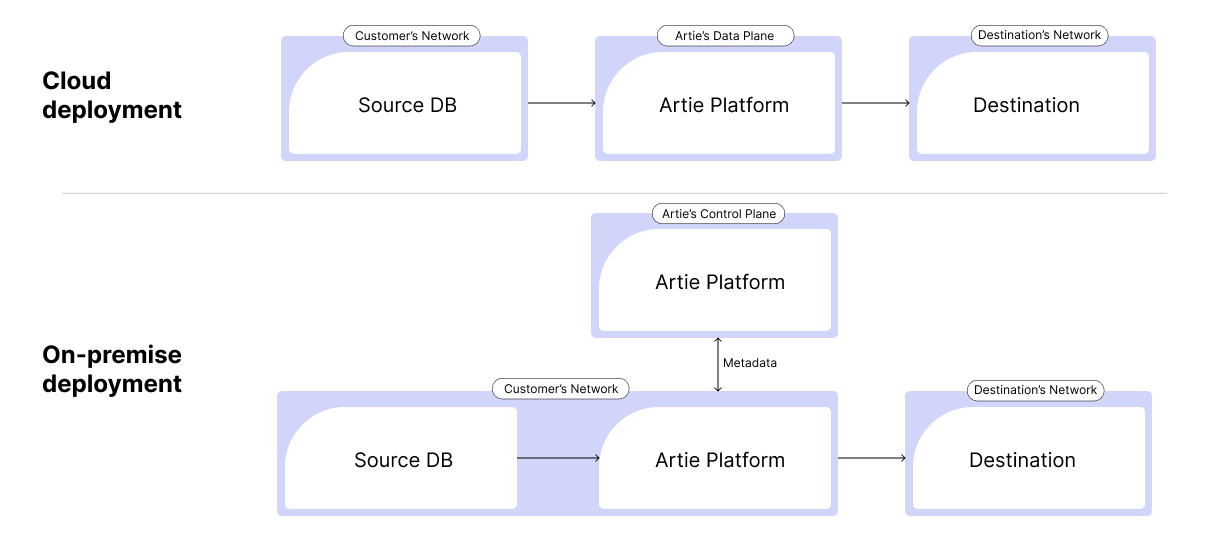
How data flows
Artie replicates database changes in near real-time using a reader-buffer-writer pattern:- Change capture (reader) - Artie connects to your source database and subscribes to its transaction log to capture changes. During backfills, a separate process scans full tables and writes directly to the destination while CDC continues in parallel.
- Buffering (Kafka) - Each change event is published to an internal Kafka queue. This buffer enables parallelism and absorbs throughput spikes when downstream systems are slow.
- Flush to destination (writer) - When a flush condition is met, Artie writes the buffered data to the destination using idempotent upserts or merges, commits the Kafka offset, and resumes reading.
- Metadata to control plane - Only pipeline configuration, status, and metrics are sent to the control plane. No row-level data is transmitted.
Deployment options
Cloud
Both the control plane and data plane run in Artie’s cloud infrastructure. The data plane is co-located in the same region as your databases to minimize egress costs and latency.- Fully managed with minimal operational overhead
- Data flows from your source, through Artie’s data plane, to your destination
BYOC (on-premise)
The data plane runs inside your cloud account or private network. Artie hosts the control plane and manages upgrades and scaling. This is the most common on-premise model. You host the data plane infrastructure (Kubernetes, Kafka, persistent storage), while Artie manages operations remotely.- All database connections originate inside your environment
- Production data never leaves your VPC
- Control plane communicates with the data plane over HTTPS (TLS 1.3) via authenticated endpoints
Security
Networking
Artie supports multiple methods for connecting to your sources and destinations:- PrivateLink - Traffic stays within the cloud provider’s private backbone with no public internet exposure. Supported on AWS, Azure, and GCP.
- IP allowlisting - Artie provides fixed IP ranges that you allowlist on your database firewall.
- SSH tunnels - Customer-initiated outbound SSH tunnels with no inbound firewall rules required.
Encryption
- In transit - All traffic between planes and between Artie and your databases is encrypted with TLS 1.3.
- At rest - Data at rest is encrypted with AES-256.