Destinations
BigQuery
Connect Artie to BigQuery with a service account key, choose where your data lands, then set query priority and a reservation.
Required settings
Artie needs these values to write to BigQuery. Each field name matches its label in the Artie dashboard.
| Field | Required | What to enter |
|---|---|---|
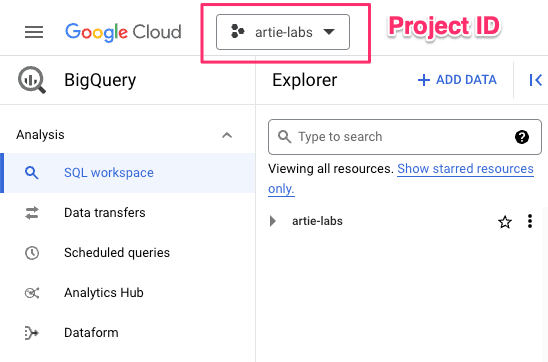
| Project ID | Yes | Your GCP project ID: 6 to 30 lowercase letters, digits and hyphens, starting with a letter and not ending with a hyphen. |
| Region type | Yes | Multi-region or Single region. Multi-region is preselected. |
| Multi-region location or Single region location | Yes | The location of your dataset. Multi-region offers US and EU, with US preselected. Single region lists regions such as us-central1. |
| Credentials data | Yes | The full contents of a service account’s JSON key file. |
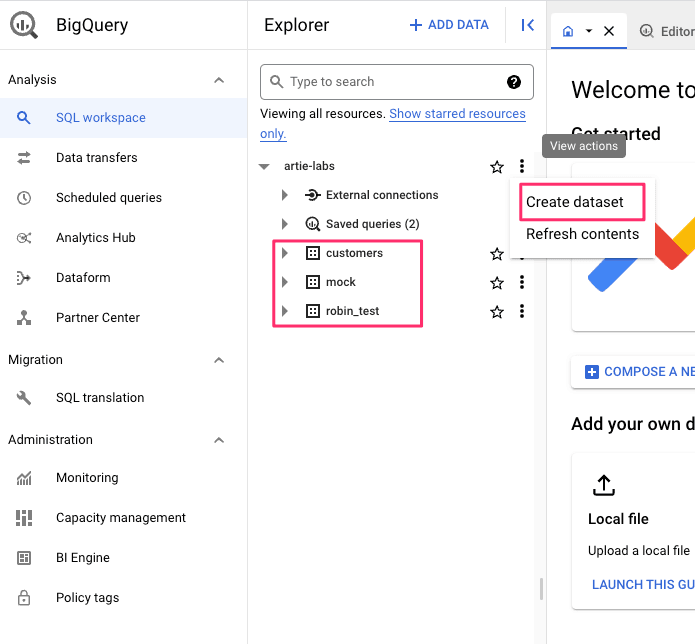
| Dataset name | Yes | The dataset Artie writes to. Pick one from the list or create one. |
Find your project ID
In the BigQuery console, the project ID is at the top of the navigation bar.
Find your dataset name
In the BigQuery console, the dataset name is on the left side of the screen.
Create a service account key
Artie signs in to BigQuery with a service account key. Create the key in the GCP console:
- Go to IAM & Admin, then select Service Accounts.
- Select Create service account, give it a name, then select Create and continue.
- Grant the BigQuery Data Editor and BigQuery Job User roles, then select Continue and Done.
- Open the service account, then select Keys, Add key and Create new key.
- Choose JSON, then select Create. A JSON file with your credentials downloads.
Artie accepts service account keys only: the JSON must contain "type": "service_account". To reuse a service account that already has these roles, skip to step 4.
Add BigQuery to a pipeline
When you create a pipeline, the setup flow reaches Choose your destination after you choose tables.
- On Choose your destination, select BigQuery.
- On Connect BigQuery, enter Project ID.
- Set Region type, then select the location of your dataset.
- Paste the contents of the JSON key file into Credentials data.
- In Dataset name, select a dataset.
- Select Verify destination. Artie shows “Destination verified”.
- Select Continue.
To create a dataset instead, type its name in Dataset name and select Create “NAME”, where NAME is the name you typed. Then select Create dataset in the Add a new dataset dialog.
To verify at a later time, select Verify later instead of Verify destination.
Two conditions change this step:
- If you chose an existing BigQuery connector, the step shows its details in place of the connection fields. Set Dataset name for this pipeline.
- If the pipeline has no tables yet, the button reads Test connection. It checks the connection only, so choose tables and then verify.
Query priority
BigQuery schedules queries in one of two priority modes. Artie uses INTERACTIVE by default.
| Mode | Description |
|---|---|
| INTERACTIVE | Queries have higher priority and start as soon as compute is available. Best for time-sensitive operations where low latency is critical. |
| BATCH | Queries have lower priority, so they can wait longer in the queue before they start. Best for large, non-urgent workloads. |
To switch a new pipeline to BATCH, open Advanced options on the Connect BigQuery step. Then turn on Batch priority under Cost and speed.
To switch an existing pipeline, follow these steps:
- On the pipeline’s page, select Edit pipeline.
- Open the Destination: BigQuery tab, then expand Advanced settings.
- Under Optimizations, select Use batch query priority.
- Deploy the pipeline to apply the change.
Pricing model considerations
The effect of query priority depends on your BigQuery pricing model.
With on-demand pricing, you pay per byte scanned in either priority mode. The modes differ in two ways:
- INTERACTIVE queries have higher priority. Up to 1,000 can wait in the queue per project per region.
- BATCH queries have lower priority. Up to 20,000 can wait in the queue per project per region.
BigQuery sets how many queries run at once from the compute available, so there’s no fixed concurrent query limit.
Recommendation: Use INTERACTIVE unless your project fills the interactive queue during peak replication. BATCH queries can wait longer to start, which adds replication lag.
With capacity slots (BigQuery Editions), you pay for reserved compute capacity. The modes differ in two ways:
- INTERACTIVE queries have higher priority. Queued INTERACTIVE queries start ahead of queued BATCH queries, even when they were submitted later.
- BATCH queries are more likely to wait in the queue while the reservation uses all its slots. Once started, they run the same as INTERACTIVE queries.
Recommendation: Use INTERACTIVE. You pay for dedicated slots, so you want your CDC queries to run immediately instead of waiting behind other workloads.
Advanced options
These settings are optional. On a new pipeline, they sit under Advanced options on the Connect BigQuery step. On an existing pipeline, they sit under Advanced settings on the Destination: BigQuery tab, with the labels in the second column.
| Setting | Label when editing a pipeline | What it does |
|---|---|---|
| Reservation | Reservation name | Runs this pipeline’s BigQuery jobs on the reservation you pick. |
| BIGNUMERIC for variable numerics | Use BIGNUMERIC for variable numeric columns | Stores numeric columns without a fixed precision as BIGNUMERIC instead of NUMERIC. Shown for PostgreSQL, Oracle, CockroachDB, Amazon Keyspaces and Snowflake sources. |
| Truncate oversized values | Truncate exceeded values | Trims extra decimal places so a numeric value fits its column. |
Artie lists the reservations in your connector’s location. The list needs the reservations.list and reservations.use IAM permissions on the service account whose key you entered in Credentials data. If Artie can’t load the list, the field is disabled.
Best practices
Partition your large tables to improve merge performance and reduce costs. Artie can create new tables partitioned by hour, day, month or year.
To understand BigQuery’s pricing models and avoid unexpected bills, review the capacity pricing guide.
Was this page helpful?
- Need help? Message us on Slack or email [email protected].
- Want a walkthrough? Book a demo.
- LLM? Read llms.txt.