
Data & Engineering Innovators Spotlight: Lucas Chapin, Head of Data at Hummingbird

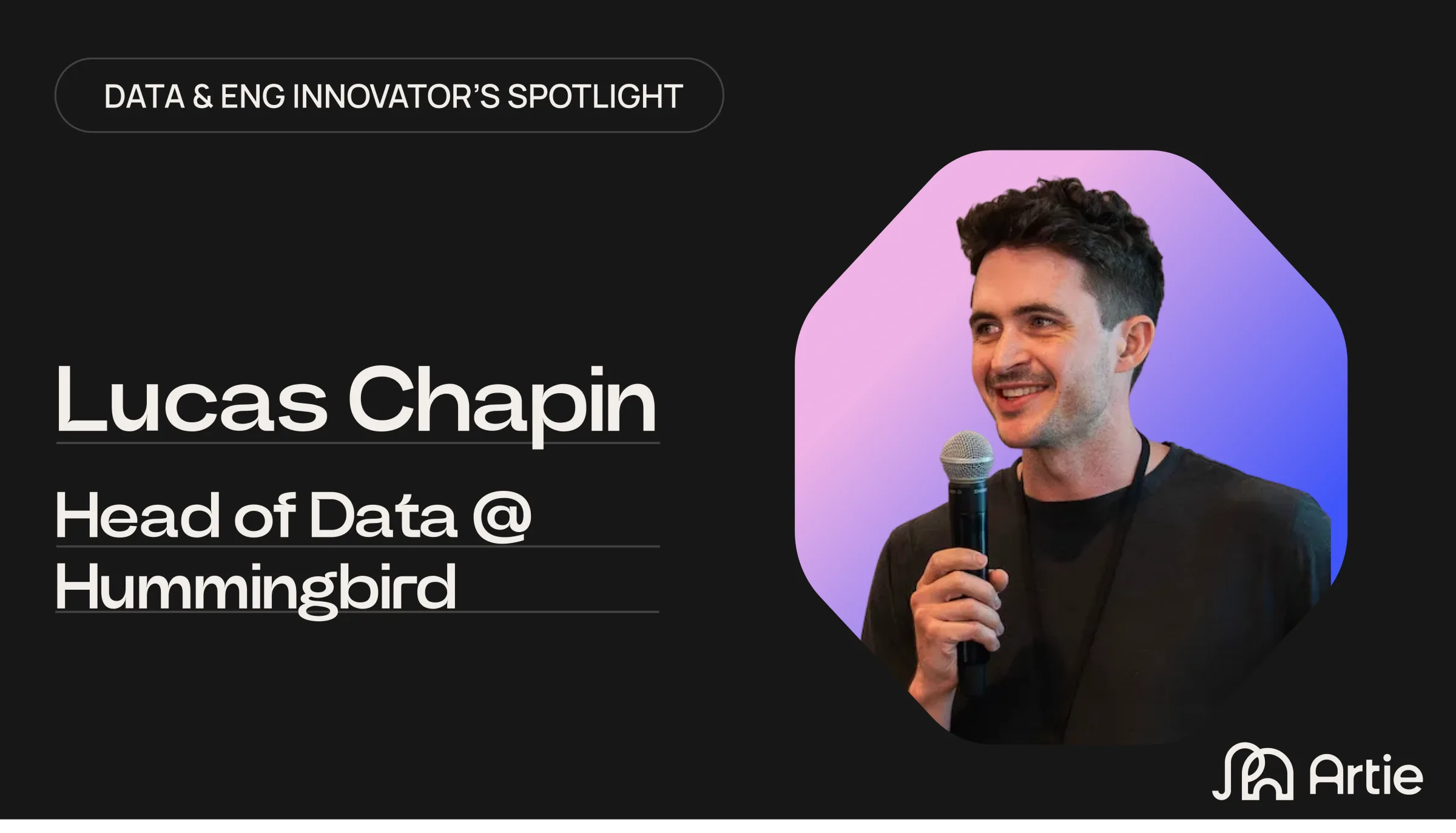
As part of Artie’s Data & Engineering Innovators Spotlight, we profile leaders shaping the future of modern data infrastructure, real-time data systems, and AI-driven engineering. This series highlights the practitioners designing scalable architectures, modernizing legacy stacks, and pushing the boundaries of what data engineering teams can achieve.
Today we’re excited to highlight Lucas Chapin, Head of Data at Hummingbird and a leader widely recognized for building reliable, adaptable data platforms for business-critical operations and ML workloads.
About Lucas: A Leader in Modern Data Engineering
Lucas Chapin is an engineering leader building AI-powered products in the FinTech space. He brings over 10 years of experience across AI/ML, MLOps, data engineering, and analytics, leading teams that turn complex data systems into real-world, high-impact solutions. Outside of his operating role, Lucas is an active angel investor backing the next wave of Bay Area startups, supporting founders at the forefront of innovation.
Interview With Lucas - Insights on Data Architecture, Real-Time Systems, and Engineering Leadership
Q1. How has the role of a data engineering leader evolved since you started your career?
I started my career back when compute was expensive and dimensional modeling reigned supreme. The industry has changed a lot since then, both with cheap and elastic compute and the needs of a federated data layer to support many applications such as BI, analytics, machine learning, and AI. Data engineering has shifted from optimizing for scarcity to designing scalable platforms, and challenges such as governance, observability, and streaming have supplanted the quaint days of batch jobs and star schemas.
Q2. What drew you into data engineering originally?
My first professional exposure to data engineering was at Facebook over a decade ago when it was becoming clear that data is a competitive asset and entirely new machine learning based products were only possible with a rich foundation of proprietary data to build upon. I was drawn to this idea of personalization where product experiences could be specifically tailored to individual preferences based on inferences we could make about what they like and dislike. Finding signal among the noise felt like a puzzle to be solved, with data engineering providing the base layer upon which to draw insights.
Q3. How do you see real-time data shaping businesses over the next few years?
Having built ML products, one of the most striking technical differences in the Age of AI is that companies are (for the most part) all using the same frontier models provided by the AI labs. Models and the internals of model building (feature engineering, hyperparameter tuning, etc.) are no longer a competitive advantage. Instead, the advantage for companies like ours who focus on applied AI comes from solving the data fragmentation issue: making sure that AI products are able to access the right data with the right context for intelligent decision making in real time. We'll continue to see data integration, embedding pipelines, and low latency context retrieval play pivotal roles in building trustworthy and accurate AI products.
Q4. What use cases pushed your team to invest more heavily in real-time data?
Our company ran into a classic startup problem when our customer facing analytics dashboards started getting slower and even hitting occasional query timeouts running on relational database technology. To solve this, we swapped the dashboard backend over to our data warehouse, but while queries ran quickly we found that customers were using our analytics products in operational ways we didn't anticipate, and even a 5 minute delay could cause friction. As an example, customers use our platform for assigning work across their workforce and want an intelligent way to know which employee should take on which case. Near real time replication with Artie has allowed us to meet customer needs for assigning work and seeing their workloads and capacity rebalance immediately, allowing them to assign work optimally.
Why Leaders Like Lucas Chapin Inspire the Future of Data Engineering
Innovators like Lucas Chapin are redefining what modern data engineering looks like - from real-time data architectures to AI-powered operational systems. Their insights help teams rethink scalability, data quality, and the future of intelligent infrastructure.
At Artie, we’re proud to feature leaders building the next generation of data platforms, CDC pipelines, and real-time analytics systems.
If you're advancing your company’s data infrastructure, we’d love to spotlight your work in a future edition.


